| Travel distance | 49 miles |
|---|---|
| Fastest time | 1h 05m |
| Daily trains | 48 |
| Ticket from |
Traveling south from the picturesque Swiss city of Lugano to the fashion and financial powerhouse of Milan involves a short but highly scenic journey of approximately 49 miles. This international rail corridor takes passengers from the dramatic, palm-fringed shores of Lake Lugano, through the Swiss-Italian border, and straight into the expansive plains of Lombardy. With a fastest travel time of just 1h 05m, the train is the ultimate travel choice, offering a swift, stress-free alternative to navigating mountain highways and heavy urban traffic.
Selecting Your Cross-Border Train Options
The rail connection between Lugano and Milan is exceptionally robust, with approximately 28 daily trains keeping the two lakeside and metropolitan hubs closely linked. Travelers can choose between two main train types:
-
EuroCity (EC): Operated jointly by Swiss Federal Railways (SBB) and Trenitalia, these premium international trains provide the fastest direct link (~1h 05m) to Milano Centrale. They offer comfortable seating, climate control, power outlets, luggage racks, and often an onboard bistro carriage.
-
TILO (Treni Regionali Ticino Lombardia): These frequent regional trains (primarily the RE80 line) provide a highly reliable and direct connection between Ticino and Lombardy, terminating at either Milano Centrale or Milano Porta Garibaldi. They are slightly slower but offer excellent scheduling flexibility and fixed regional pricing.
To secure the most competitive rate on EuroCity services, which can start from $21.00, it is highly recommended to book your tickets digitally in advance, as high-speed international fares rise closer to the departure date.
Essential Tips for International Rail Travelers
Crossing the Swiss-Italian border by train is straightforward, but keeping a few key practicalities in mind ensures a seamless journey:
-
Border Controls: Although both Switzerland and Italy are part of the passport-free Schengen Area, you must carry a valid passport or national ID card, as random border customs checks are occasionally conducted on board or at the border station of Chiasso.
-
Currency: Switzerland uses the Swiss Franc (CHF), while Italy uses the Euro (EUR). Credit cards are universally accepted at both stations, but it is useful to have a small amount of the correct local currency for minor purchases.
-
Ticket Validation: If you are traveling on a regional TILO service using a physical paper ticket, you must validate it in the orange or green electronic stamp machines at the station before boarding. Digital tickets purchased online do not require physical validation but must be ready on your smartphone for inspection once the journey has commenced.
The station is spectacularly situated on a hillside overlooking the city and the lake, providing an immediate panoramic vista. Directly outside the main entrance is a historic, automated funicular that provides a frequent two-minute descent to the historic center and the lakeside plaza. The terminal is highly modern and easy to navigate, offering automated ticket kiosks, a staffed SBB travel center, currency exchange, secure luggage lockers, and several cafes where you can grab a quick Swiss chocolate or espresso before boarding.
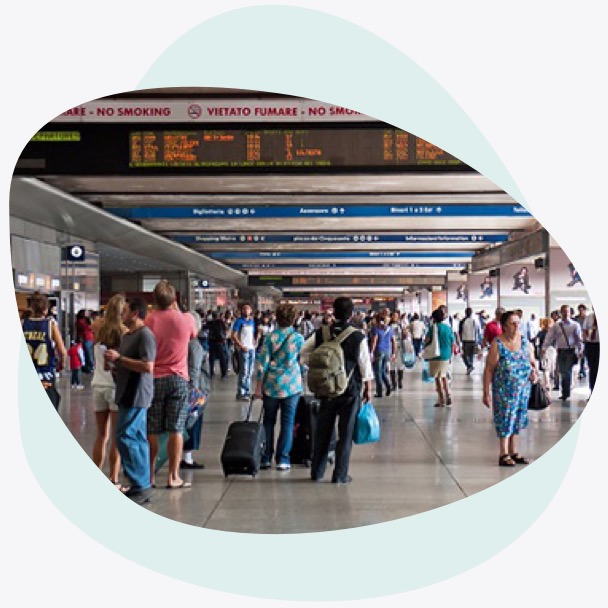
Arriving at this world-famous architectural masterpiece places you at the absolute epicenter of Northern Italy's transport network. The station is a massive multi-level facility with the main train platforms located on the top floor and the metro lines (Yellow M3 and Green M2) situated in the basement for immediate access to the Duomo or the Brera district. Travelers will find every possible amenity here, including secure luggage storage, international currency exchanges, and a vast selection of high-end shopping and dining options. Taxis are located directly outside the grand front entrance.